


Bringing home a puppy is exciting, exhausting, and ultimately deeply rewarding. In those first few weeks, every choice can feel important. What they eat, where they sleep, how they meet the world and how you support their growing body all shape the foundation they’re building. The good news is that giving your puppy the best start doesn’t require perfection. It comes down to three foundations: a safe environment, a healthy diet, and targeted support where it genuinely makes sense.
Create a safe, low stress start at home

Your puppy’s first weeks at home shape how they learn, bond and cope with the world. This doesn’t mean wrapping them in cotton wool but rather creating predictability while they adjust.
Set up a calm sleeping area, keep mealtimes consistent, introduce household noises gradually, and avoid overwhelming them with too many visitors or outings at once. Puppies need socialisation, but they also need recovery. The first three months of life are the most important period for puppy socialisation, but exposure should be safe and not so intense that it causes excessive fear, withdrawal or avoidance.
A healthy start also means protecting them from preventable risks, such as unsafe plants, toxic foods, open staircases, slippery floors, chewable cords, rough play, and contact with unknown or unwell dogs before vaccination protection is complete. Think of your home as your puppy’s ‘training ground’ for both safety and confidence.
Know what a healthy puppy should look like

A healthy puppy should be bright, curious, playful, and eager to eat. Their stools should be reasonably formed, their coat should look clean and soft, and their energy should come in waves: play, eat, sleep, repeat.
It’s normal for puppies to have quiet days, but persistent lethargy, vomiting, diarrhoea, poor appetite, coughing, pale gums, bloating, excessive scratching, or failure to gain weight should never be ignored. Puppies can deteriorate quickly, so it’s always better to check in early with your vet.
Body condition is important too. Excess weight places unnecessary pressure on developing joints, while underfeeding can compromise growth. You should be able to feel the ribs under a light covering, see a waist from above, and notice steady, as opposed to explosive, growth.
Choose a diet formulated for growth

Puppies are not simply small adult dogs. They have higher requirements for energy, protein, vitamins and minerals and key nutrients involved in skeletal, immune and neurological development. Diets for growth and reproduction require higher minimum protein than adult maintenance diets, and puppy nutrition must be appropriate for their life stage.
This is why puppies should be fed a food or recipe that is clearly complete and balanced for growth. If feeding commercial food, check the label. If home-preparing, use a recipe formulated by a veterinary nutritionist or qualified canine nutritionist, and don’t rely on meat, rice, vegetables or ’80:10:10’ style ratios alone. Calcium and phosphorus balance is especially important during growth, particularly for large and giant breed puppies.
Transition food slowly
Many puppy-related tummy upsets come from changing food too quickly. Even high-quality food can cause diarrhoea if introduced abruptly.
A simple transition is to replace around 10-20% of the old food with the new food, then increase gradually every few days if stools remain stable.

Sensitive puppies may need 10-14 days or longer. During this period, avoid adding new treats, chews or supplements all at once, because if stools change you won’t know what caused it.
Feed for steady, healthy growth
Most young puppies do best with three to four smaller meals each day, then gradually move to fewer meals as they grow and can comfortably manage larger portions. Smaller, regular meals are gentler on digestion and help maintain more stable energy. As your puppy develops, portion sizes should be adjusted based on body condition, growth rate and activity level, not just the feeding guide on the packet.
Overfeeding is one of the easiest mistakes to make during puppyhood. The goal is not fast growth, but rather steady development, strong foundations and a lean, healthy body.
Where targeted support fits in

Supplements should never replace a complete diet, but some can be genuinely useful during puppyhood when chosen for the right reason. The most relevant supports are those that help stabilise the gut, support immune development and provide targeted nutrients without over-complicating the bowl.
Bovine Colostrum

Colostrum is one of the most appropriate early-life supports because it nurtures the gut-immune connection. Bovine colostrum naturally contains immunoglobulins, lactoferrin, growth factors and other bioactive compounds that support mucosal immune defence and gut barrier function. In dogs, dietary bovine colostrum has been shown to increase faecal IgA, improve vaccine antibody response, and support greater gut microbiome diversity and stability; all useful markers of gut-immune resilience.
Puppyhood is a period of rapid development, when the immune system, intestinal lining and gut microbiome are still maturing. In a controlled trial, recently weaned puppies undergoing changes in both diet and environment were supplemented with bovine colostrum for 10 days. These puppies showed improved faecal quality compared with those given skim milk powder, suggesting that colostrum may help support digestive resilience during stressful early-life transitions such as weaning, moving homes and changing diets.
Gut Protect
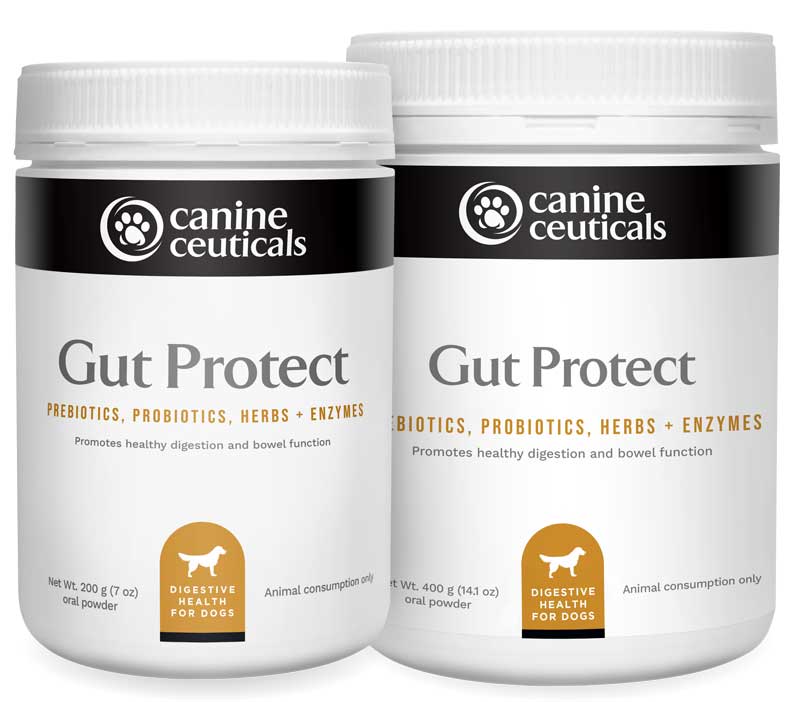
Gut Protect is more targeted toward day-to-day digestive function and stool quality. It’s the product to reach for when a puppy is having soft or variable stools, mild tummy sensitivity, food-transition-related gut issues, gas, or is generally in need of extra digestive support. Its prebiotics, probiotic, digestive enzymes, digestive herbs, and psyllium help support microbial balance, nutrient breakdown and more consistent bowel motions. Microbial balance is particularly crucial, because the gut microbiome is involved in gut lining health, immune activity, metabolism and healthy development.
The key is to introduce it slowly. Puppies do best when changes are steady and measured, so start with a small amount and build gradually if stools remain stable. If your puppy is thriving on a complete diet with normal stools, Gut Protect may not be needed every day. If they are sensitive or going through a transition, it can be a valuable addition.
Marine omega-3 support
Omega-3 fatty acids, especially EPA and DHA from marine sources, help support healthy skin and coat, brain and eye development, joint comfort, and balanced inflammatory signalling. A complete puppy diet should already meet essential fatty acid requirements, but puppies may benefit from a measured marine lipid addition, particularly when skin, growth, joint stress or inflammatory resilience are key priorities.

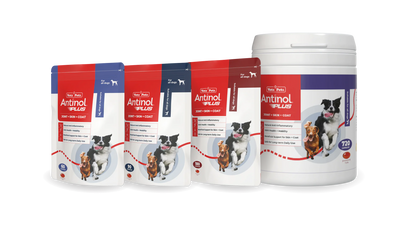
Antinol® Plus provides EAB-277™, a concentrated marine lipid blend derived from green-lipped mussel and high-phospholipid krill oil. This gives a broader spectrum of marine lipids than fish oil alone, including phospholipid-bound omega-3s, which may support efficient absorption. Importantly, it provides a valuable source of DHA, a long-chain omega-3 that is especially important while the puppy brain, nervous system and retina are developing. In one study, puppies fed a DHA-rich diet from eight weeks of age performed better in measures of learning, memory, visual function and early psychomotor development, and showed a stronger early antibody response following vaccination. A more recent controlled study found that puppies supplemented with DHA-rich fish oil for 90 days performed better in a learning task, had higher circulating EPA and DHA levels, and showed no increase in lipid oxidation. Although these studies tested DHA-rich fish oil rather than Antinol® Plus itself, they support the value of marine-derived DHA as part of a puppy’s nutritional foundation for cognitive, visual and neurological development.
Antinol® Plus should be given with food, and like any oil-based supplement, its calories should be considered as part of the total diet. For most healthy puppies, it can sit alongside a complete and balanced growth diet as a daily foundational support.
The bottom line

The best start in life is built through small, consistent choices: a calm home, safe socialisation, complete nutrition, steady growth, and targeted support when needed. Raise the puppy in front of you, move slowly with changes, and use supplements thoughtfully as an extra layer of support rather than a replacement for the fundamentals.
Want to keep learning?
If you'd like a deeper dive into puppy nutrition, from choosing the right food and managing the transition, to supporting gut health and joint development along the way, our Essential Guide to Puppy Health and Nutrition walks through everything you need to know. It's a great next stop for pet parents who want to feel confident about what's going in the bowl.

References (click to expand)
American Veterinary Society of Animal Behavior. (2008). AVSAB position statement on puppy socialization. https://avsab.org/wp-content/uploads/2018/03/Puppy_Socialization_Position_Statement_Download_-_10-3-14.pdf
Barko, P. C., McMichael, M. A., Swanson, K. S., & Williams, D. A. (2018). The gastrointestinal microbiome: A review. Journal of Veterinary Internal Medicine, 32(1), 9-25. https://doi.org/10.1111/jvim.14875
Giffard, C. J., Seino, M. M., Markwell, P. J., & Bektash, R. M. (2004). Benefits of bovine colostrum on fecal quality in recently weaned puppies. The Journal of Nutrition, 134(8), 2126S-2127S.
Rodrigues, R. B. A., Zafalon, R. V. A., Rentas, M. F., Risolia, L. W., Macedo, H. T., Perini, M. P., ... & Brunetto, M. A. (2023). The supplementation of docosahexaenoic acid-concentrated fish oil enhances cognitive function in puppies. Animals, 13(18), 2938. https://doi.org/10.3390/ani13182938
Sanderson, S. L. (2024, September). Nutritional requirements of small animals. MSD Veterinary Manual. https://www.msdvetmanual.com/management-and-nutrition/nutrition-small-animals/nutritional-requirements-of-small-animals
Satyaraj, E., Reynolds, A., Pelker, R., Labuda, J., Zhang, P., & Sun, P. (2013). Supplementation of diets with bovine colostrum influences immune function in dogs. British Journal of Nutrition, 110(12), 2216-2221. https://doi.org/10.1017/S000711451300175X
Zicker, S. C., Jewell, D. E., Yamka, R. M., & Milgram, N. W. (2012). Evaluation of cognitive learning, memory, psychomotor, immunologic, and retinal functions in healthy puppies fed foods fortified with docosahexaenoic acid–rich fish oil from 8 to 52 weeks of age. Journal of the American Veterinary Medical Association, 241(5), 583-594. https://doi.org/10.2460/javma.241.5.583
